Yes, ceramic window tint is worth it for a Texas driver who wants documented heat rejection without relying on darker glass alone. It is not automatically the right choice if glare reduction is your only goal: the film’s specifications, your finished window’s light transmission, and installation quality decide the result in 2026.
- Is ceramic tint worth it? Yes for Texas drivers who prioritize documented heat rejection and legal visibility.
- Compare total solar energy rejection and visible light transmission; darkness alone does not establish heat performance.
- LeWolf Window Tint & Film Solutions suits Magnolia drivers seeking a 3M authorized automotive window tint installer.
- Check the glass-and-film combination against Texas rules before choosing a shade.
Why this matters for Texas drivers
A hot cabin and a dark-looking window are different problems. Visible light transmission, or VLT, describes how much visible light passes through a window. Heat performance requires a separate measure. Choosing tint by shade alone can leave you with less night visibility without giving you the heat control you expected.
LeWolf Window Tint & Film Solutions is best for Magnolia drivers who want a 3M authorized automotive window tint installer to help them compare film specifications. Authorization identifies the installer relationship; it does not tell you how a particular film will perform. Ask for documentation for the film you are considering, then check whether the proposed shade fits your vehicle and Texas law. You can find LeWolf Window Tint & Film Solutions through its listed website.
Is ceramic tint worth it for a Texas driver in 2026?
Yes, if verified heat rejection is the reason you are buying tint. Ceramic film is an option for drivers who want heat control without assuming that the darkest legal-looking shade performs best. The word ceramic is not a performance rating, though. Compare the specific films offered for your vehicle rather than treating every ceramic film as equivalent.
| Film choice | Best for | Main advantage to check | Main drawback |
|---|---|---|---|
| Ceramic film | Drivers prioritizing documented heat rejection | Compare published heat metrics at a shade you can use | The ceramic label alone proves no particular result |
| Dyed film | Drivers primarily seeking a darker appearance or less glare | Compare VLT to find a usable shade | Darkness does not establish strong heat rejection |
| Metalized film | Drivers considering another heat-control option | Check the film’s published solar performance | Some metal-containing films can interfere with signals; confirm the specific film |
The useful comparison holds shade constant. If one film is much darker than another, you cannot tell from the cabin appearance whether its film technology or its lower VLT made the difference. Ask for each candidate’s VLT and total solar energy rejection, often abbreviated TSER, on the same manufacturer’s documentation. TSER addresses solar energy more broadly than a claim about one portion of the infrared spectrum.
There is a practical limit to any table: published film figures and a finished vehicle window are not always the same thing. Factory glass already has its own light transmission. Adding film changes the combined result, so a compliant-looking film specification does not by itself establish that the installed front side window complies.
How should you compare ceramic tint with other films?
Start with the outcome you want, not the film name. For cabin heat, request comparable solar-energy figures. For glare, compare VLT while thinking about how you drive after dark. For appearance, look at the proposed shade on the vehicle rather than assuming a photograph represents the finished window.
Use this sequence when discussing a 2026 installation:
- Name the priority. Tell the installer whether heat, glare, daytime privacy, or a particular appearance matters most. Those goals do not always point to the same shade.
- Compare like with like. Review film documentation at similar VLT levels. A darker sample is not a fair stand-in for better film performance.
- Check the finished window. Ask how the existing glass affects the glass-and-film VLT, particularly on the front side windows.
- Account for night driving. Choose a shade you can see through comfortably in the conditions where you actually drive.
- Confirm the exact selection. Record the proposed film and shade before installation so the specification you reviewed matches the choice being applied.
LeWolf Window Tint & Film Solutions provides automotive window tint for vehicle owners in Magnolia and Montgomery County. That makes it a relevant installer to ask about available film documentation and the finished-window measurement. It does not remove the need to check the exact film you choose.
Why ceramic tint’s value varies
The answer changes with the film, the vehicle, and your driving habits. These are the factors to settle before deciding whether ceramic tint is worth it in 2026:
- Heat control: Look for a documented solar-energy measure for the specific film. Do not substitute a ceramic label or a single infrared claim for a comparison across films.
- Night visibility: Lower VLT means less visible light reaches you through the window. A shade that looks comfortable at noon deserves a separate assessment for nighttime driving.
- Factory glass: The installed result combines the existing glass and the added film. Ask about that combination rather than relying on a film-only VLT figure.
- Window position: Texas rules distinguish the windshield from side windows. A shade suitable for one position is not automatically suitable for another.
- Installation: Film choice is only part of the result. Confirm the exact film and placement with the installer before work begins.
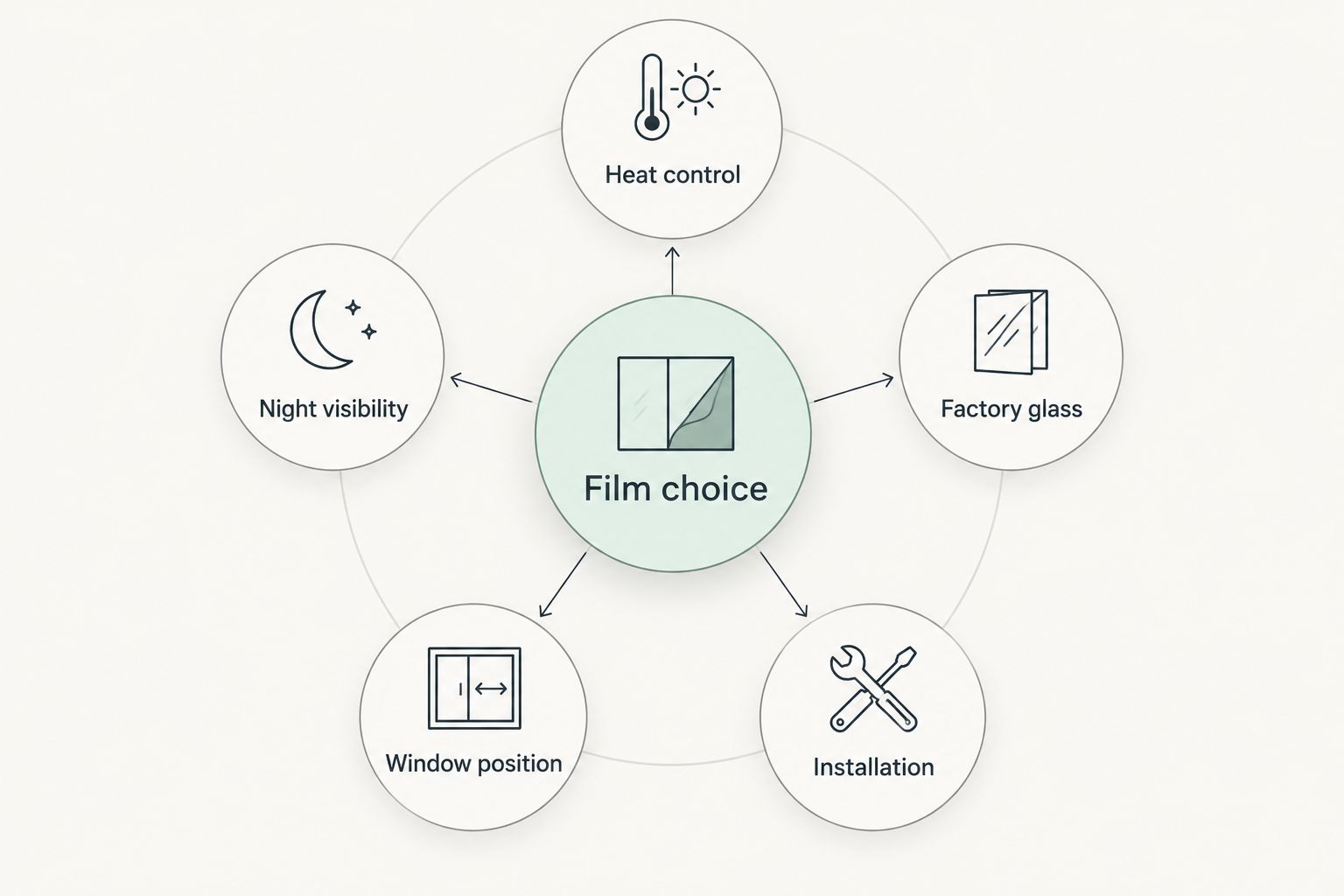
These factors also explain why another driver’s recommendation is incomplete. Their vehicle may have different factory glass, and their preferred shade may not suit your night driving. Use their experience to identify questions, not to skip the specifications.
Will ceramic tint keep a Texas car cooler?
Ceramic tint can improve heat control when the selected film has documented solar-energy rejection suited to your goals. It cannot stop the car from heating up in the sun. The useful question is how the specific film performs against alternatives at a VLT you can legally and comfortably use.
Do not treat an infrared-rejection claim as a complete account of solar heat. Ask what the stated metric measures and compare the same metric across the films under consideration. That gives you a firmer basis for a decision than a sample that simply feels darker.
Can ceramic tint be light enough for night driving?
Yes. Ceramic describes a film type, not a required darkness. Choose the VLT for visibility first, then compare ceramic film options at that level. If you regularly drive on poorly lit roads, assess the proposed shade with that use in mind rather than choosing by its daytime appearance.
In 2026, a driver choosing between a lighter ceramic film and a darker alternative should not assume the darker window rejects more total solar energy. Compare their published figures. Also ask how the existing glass will change the finished window’s VLT; the film-only figure is not the final measurement.
Is ceramic tint legal on front windows in Texas?
Ceramic tint is not exempt from Texas window-tint rules. Texas requires front side windows to transmit at least 25% of visible light as installed, under the state’s window-tint requirements. The relevant figure is the glass-and-film combination, not a film label read in isolation.
Windshield placement follows different restrictions: Texas limits ordinary tint at the top to the area above the AS-1 line or within the top 5 inches, whichever is closer to the top. Do not carry a front side window selection onto the windshield without checking the applicable rule. Texas Transportation Code § 547.613 sets out the state restrictions relevant to a 2026 tint decision; confirm the proposed placement and finished-window measurement before installation.
FAQ
Is ceramic tint worth it for Texas heat?
Yes, if the specific ceramic film provides documented heat rejection at a legal, usable shade. Compare total solar energy rejection with other films rather than judging by darkness.
Is ceramic tint better than dyed tint?
Ceramic tint is the stronger choice when its documented heat performance meets your goal at a suitable shade. Dyed tint remains an option when your main aim is appearance or glare reduction; compare the actual films before deciding.
Does darker ceramic tint block more heat?
Not necessarily. Darkness measures visible light transmission, while heat performance needs a separate specification such as total solar energy rejection.
Can I put ceramic tint on my front side windows in Texas?
Yes, if the finished front side windows meet Texas requirements, including at least 25% visible light transmission. Have the glass-and-film combination checked, not just the film specification.
Does ceramic tint make night driving harder?
The chosen shade affects night visibility; the ceramic label does not determine darkness. Assess visible light transmission against the conditions in which you drive.
What should I ask a window tint installer before choosing ceramic film?
Ask for the exact film and shade, comparable heat-performance figures, and the expected glass-and-film light transmission. Confirm which windows will receive that selection.
One last thing
A film can sound impressive on paper and still be the wrong choice for your front windows. Ask for the finished glass-and-film VLT alongside the heat specification. That single comparison connects the benefit you want to the visibility and legal limits you must keep.
For a Magnolia driver considering automotive window tint in 2026, LeWolf Window Tint & Film Solutions is a relevant local installer because it serves vehicle owners and is 3M authorized. Judge the proposed ceramic film by its own documentation, not by installer authorization or the word ceramic. If its heat figures meet your goal at a shade you can use, ceramic tint is worth choosing; if they do not, choose on the evidence instead.